Back last year I gave some pictures of the western end of Rusiec, showing that the building area is really countryside. I took the opportunity on Independence Day to go for a walk round the eastern end.
This is Gravel Road (ul Żwirowa), which, according to my mobile phone map, is a built-up area.
The road leading off to the left is Torquoise street, a model of urban tranquillity.
The other side of the road being no less an escape from urban life.
Fox Road (ul Lisia) is the southern end of the built-up area (to the left), whilst the forest is on the right. Fox Road provides an east/west back road from Rusiec, but it is virtually impassable for normal cars.
The built up area on the map ends at Radar Road, with the left side of this picture being outside it.
There are some houses already built in the non-urban section, however.
This cross immediately over the other side of the road, marks the planned site for a new church: currently open country.
The stone chip surface is new and was presumably laid for the church - other busier roads are just compacted earth. Not many people live there, from the view south further up the road.
Looking north.
It's hard to tell where the side roads are along much of Radar Road, so I turned back along the first clear track. Even this was closed by a branch railing to stop cars. I think it it is Amethyst Street (Bursztynowa), which at the Radar end is still undeveloped. The houses start further to the west.
I think this is the northern end of Gravel Road. Quite a lot of houses have been built in this part.
Even so, there are wide open spaces. Amethyst Street doesn't appear on the map. The yellow sign in the distance shows a building plot for sale. There are many such signs all over the area.
There are also houses for sale. In this case, however, the plot is said to be for sale rather than the half-built shack. I would guess it was originally intended as a summer house in the country for a city dweller.
I have this pet theory that one of the reasons that Poland is statistically a poorer country than places like the UK is simply the easy availability of building land. The UK's paucity of space creates premium disposable wealth in buildings and property, with major multiplier effects throughout the domestic economy eg the need for high incomes to pay for housing. Paradoxically, the ready availability of space provides better, more spacious living conditions in Poland, whilst having a far lower multiplier effect. People have a better quality of life even though they are poorer. Imagine what all these plots of land would be worth if they were an hour's drive from London rather than Warsaw.
Returning home along the southern main road of Rusiec - Estate or Settlement Road (Osiedlowa), I passed the rather strange collection of buildings that seem to be the oldest, still inhabited dwellings in the area. They are poor people in Poland, although they seem to have a large area of land. They grow vegetables in the empty space beside the house, so I think it is their property. I would guess that it could hold eight to ten new houses, which in England might each be worth half a million pounds or so. The land itself might therefore be worth half a million in England. It is probably unsellable in Poland except at a rock bottom price: it just has an unforcastably long-term investment value.
Finally back home, we have our own view of Rusiec.
I feel I'm opening my soul to public scrutiny. This is about my 5th attempt at writing this, as I get paranoid about translating something I feel deserves quality work. Is it right? Is it the right style? Is it worthwhile for the audience?
Sometimes the things I have done are trivial, so it doesn't matter. There must be past translations on this blog done for myself, for which the result is not important. Most weirdly, I have done "no one is gong to read it, but it's a condition of EU grant that there is an English summary" sort of thing, which I have been calm about.
There was even something I did helping someone in their English written work about Churchill, where I knew that I could help her improve, so there was no qualm of conscience on my part.
However, my first real test was in improving the English for a website on Saint Faustina. I was so enamoured by her story, that I wanted to recreate her words in a style that would be easily accessible to English readers so that they could easily understand the wonder of her vision.
I was very worried about some of the terminology I was using in making the story accessible, but this I could forgive myself: my attempts to discuss this with the nun who asked that I do it met continuously with prevarication: we never met. The biggest upset I had, however, was that I changed the words of the Saint. This was absolutely true, as the complexity of her language could not be translated word for word into English and make sense, even less get over her character and mission. Sentences needed to be rearranged and shortened: I particularly remember the phrase "the painter who painted the painting", which made sense in Polish, but sounds stupid in English.
Why did I care? Sister Faustina's story is worth knowing by those who believe in the miraculous power of the individual, whether religious or not. She was a lowly nun who was thought to be crazy by her religious colleagues around her, but yet created one if the great religious paintings known to the modern world.
One of my 'still to do things before I die' list of pending work is to write her story to my satisfaction.
I am avoiding the issue, however.
Bożena Trabulsje is the mother of a long time friend of ours, Mariola. Mariola suggested that I look at the professional translation that, with long delays, Bożena had received for her book. Since then, Bożena has become our friend as well.
I had realised some years before, when working in Poland, that I could not understand an English translation without looking at the Polish original, but even so, this professional translation was the worst I had ever seen. I started from Bożena's original, but I found that I was reading more than descriptive text, it seemed to me to be poetry. It was purely instinctive on my part, but a short time ago, after a recent visit by Bożena, I put this to the test. Taking two sentences at random, I found the following blank verse poetry:
Wiele z nich,
rozsypanych w proch,
z wolna wtapia sie w pejzaż regionu,
okrywając się płaszczem
stepowej flory
czy zwałami piasku.
Inne stawiają opór
niszczycielskiemu działaniu czasu
oraz beztroskiemu często człowiekowi,
dzięki czemu jeszcze dziś
urzekają pięknem starożytnej kultury i sztuki
zamkniętej w kształtach świątyń,
bajkowych wręcz kolorach mozaik
czy w pięknie ikon.
My translation for this is:
Many of them,
scattered like dust,
slowly settle into the surrounding landscape,
covered by a coating of plants
in the Syrian steppe
or overwhelmed by drifts of sand.
Others stand resistant
to the destructive work of time and,
too often unconcerned humanity,
and bewitch us still today
with the beauty of ancient culture and art,
held together in churches,
fabulous coloured mosaics
and beautiful pictures.
I could work on this for ages trying to get it better, but I think it is a fair reflection of the original.
Bożena's original text is straight forward prose:
Wiele z nich, rozsypanych w proch, z wolna wtapia sie w pejzaż regionu, okrywając się płaszczem stepowej flory czy zwałami piasku. Inne stawiają opór niszczycielskiemu działaniu czasu oraz beztroskiemu często człowiekowi, dzięki czemu jeszcze dziś urzekają pięknem starożytnej kultury i sztuki zamkniętej w kształtach świątyń, bajkowych wręcz kolorach mozaik czy w pięknie ikon.
My normal text version became:
Many of them, scattered like dust, slowly settle into the surrounding landscape, covered by a coating of plants in the Syrian steppe or overwhelmed by drifts of sand. Others stand resistant to the destructive work of time and, too often unconcerned humanity, and bewitch us still today with the beauty of ancient culture and art, held together in churches, fabulous coloured mosaics and beautiful pictures.
Knowing that Polish is structured very different from English and knowing that poetic English is very much of narrow interest, I don't know if this is even approaching an acceptable translation. However, failing to get across the beauty of the words, would in itself be a failure.
I haven't read the book in English even though I have a couple of copies. There are some completely stupid mistakes in the English that I immediately see accusing me of incompetence. I have worked hard in my mind to make excuses. I think they are fair and valid excuses, but I knew the potential at the time ... and ignored it.
There is an easy question for me: why do I care? Bożena is a friend. Her language is beautiful and I want to reflect that: an ego thing. However, she has depicted what was, before recent revolutionary fervour, a Syria and historic Greater Syria as the centre of the evolution of much that is valued in modern civilisation. I see a kindred about my feelings for Poland with what Bożana, a Pole, feels for Syria.
Although I've got used to most of the idiosyncrasies of Polish driving, what can really scare me is the practice of going round blind bends on the wrong side of the road. I figure that, if I'm sitting in the passenger seat with the best view of what's lies round the corner, but can't see what's coming in the opposite direction, we haven't a chance. However, the ability to miss the car heading straight at us seems to be a demonstration of driving skill. I tend to close my eyes or look out of the side window.
I now drive some 11 km from Młochów to Łazy on the school run. From Falenty to Walendów, there's a clear, straight stretch of downward sloping road with no hidden outlets, which allows you to get up a good turn of speed: 80/90 kph - the speed limit - in my case, but faster for others. This photo looks in the other direction up the hill.
However, down the bottom, there's a blind bend. It's one of those bends that is just sharper and longer than you expect, but it is signposted. Even so, I misjudged it when I first went round, having to use the brakes rather than relying on changing down gear and using the engine vacuum to slow the car down, part of my current attempt at economy driving. (I suspect there's a slight optical illusion making it seem further to the bend than it actually is.)
There is the inevitable possibility, just as you get to the bend, that another vehicle will suddenly appear from the opposite direction, cutting the corner short, according to standard driving practice, on your side of the road.
Seen from the other side.
It's also standard to take a corner wide and just going a bit too fast, again standard practice, will send you well out across the road, not that the driver below has done so. Even so, comparing the pictures, you can see how tight the space is.
Still, having got used to driving the route, I thought that it might be just me being overcautious. However, after about five weeks, a car and van had collided. Since then there has been another crash, with a section of the railings by the side of the road being demolished, whilst the ground on the side of the road shows this, just near the curve.
These a bit further down.
And this, the latest, crash site. Almost all the ground marks are on the outside edge of the corner, but seem to be made by vehicles coming from both directions. This is well down from the bend and must have been the result of someone coming down the hill and around the turn at extreme speed.
Fortunately, there's a crossroads just at the bottom of the hill - the car has stopped there in the picture below - where the priority is against the crash route. Even fast drivers should not be doing more than 70 or 80 kph going up to the corner. My recommendation would be 50kph maximum. (Signs each side showing a 40 maximum limit might be helpful, but I really doubt if many drivers would take any notice of it.)
So, with the safety features in today's cars and the limited space for acceleration in one of the directions, maybe I'm still unreasonably scared. The closest I have been to having an accident was to see the rear of a car that appeared round the corner ahead of me sliding across my path, but the driver recovered well before I got there. There are no flowers or crosses beside the road, so maybe no one has died.
Even so, having turned the corner, narrowly avoiding the oncoming car or just side-swiping it, just around that bend there may be, as I have seen them, a mother with pushchair and baby, school boys larking around or someone peddling along calmly on their bicycle.
Death lies there waiting.
There are times when I feel quite happy about dangerous drivers committing suicide in their cars, but this is the sort of place where murder is just as likely. Perhaps it's just because I'm now doing a longer journey at school time, but I've been surprised recently at just how many of the very fast drivers I now see are young women (mothers?) with their children in the back seats of the car. I know that Polish women are often very tough and strong minded, but I thought they care enough about their children to think of the danger. Stupid of me, I guess.
It's strange how even people like me, who think a car is just a means of transport, can still have affection for national cars. As I never had enough money to afford a decent car in England, I have little nostalgia for the cars I had or even that friends had.
There was one near thing, though. My mate John was a motor mechanic who I helped when he was repairing cars for neighbours at the weekends - I wanted to learn how to look after my own. Many of the parts were bought from local scrap yards, who he therefore got to know. He took me one day to show me an Austin 3 Litre, a bigger, luxury version of his own 1800.
This was as near to Rolls Royce class that I could ever aspire to: they even thought it had a Rolls Royce engine. It was in good condition overall, but "needed some minor mechanical work", which I think was intended as an honest appraisal. However, the parts were difficult to get as the car was so rare, although John was eager to get to work on it. The scrapyard man just didn't want to break the car up, so it was very cheap - only slightly above what I would otherwise have thought of paying to replace my stolen Austin 1100 (in which we had just put a factory rebuilt 1300 engine, adding an improved Japanese carburettor - the thieves must have thought it was their lucky day when they opened the bonnet). However, I knew I wouldn't be able to afford the maintenance, insurance and petrol, not to mention the impossibility of finding a parking space big enough outside my house.
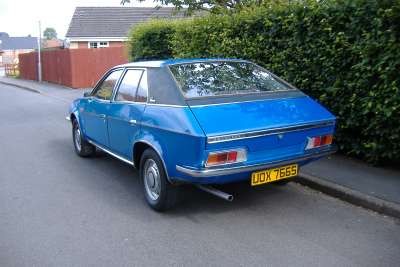
Another car I really liked the look of around that time was the then new Austin Princess. It seemed at the time to have a radically new wedge shaped look, although the pictures I have looked at don't give me the same impression now.
Except this one, that is.
Some time later, working in Poland, I drove my father-in-law's Maluch - Polski Fiat, which was a fun car to drive. I don't have any pictures of it, but it was something like this, rust and all:
Warsaw roads were much clearer in those days and drivers tended to leave the right hand lane clear. My English driving habit of staying in the slow lane let me drive past everyone, especially, but not only, at traffic lights. The Maluch's acceleration was appalling, although my change-down-gear and stoke-up-the-revs got it going, with the valves hammering the camshaft into, I suspect, shreds (assuming that's how the engine worked). I was likened to a taxi driver, intended as a compliment. Who needed a new, two halves welded together Mercedes? I have tracked Maluchs doing 120 kph on fairly flat roads, which isn't bad either, given the 90 speed limit. (The Yaris still had better acceleration and another 40 or more kph, so 'Bye Bye, little one'.)
Although I never drove a Polonez, I was impressed by the wide diversity of body works, from the standard saloon and estate, to pick-up, small and large vans, including a refrigerated version. There was quite some excitement when the Rover engine was fitted, so we went to see one in the showroom. I was asked incredulously whether I wanted one, to which the politic answer was that of course I didn't, although a more honest answer would have been that I would love to have tried it. Although they largely seem to be relegated to poor people's cars these days - you can tell poorer areas by the numbers in the car parks, they still provide the backbone to many small businesses. (The only car picture of my own on this post.)
Its days were clearly numbered, but I did think that there was one niche market that it could have been adapted to. Its heavy use as a rough use, land and road vehicle for farms particularly fired my imagination - conditions very familiar on many 'roads', paved and unpaved, in Poland as well as private dirt tracks. If the Polonez could just be given a much higher chassis clearance without exorbitant cost, it had great potential to be a cheap, no thrills, but completely practical rough use private car and commercial vehicle: not just in Poland, but everywhere. (I don't know if reliability was a real problem, as was its reputation, rather than, like Austin etc, a legacy of the failure of early models even though these were subsequently rectified.)
This is Sweet Flag Street (ul Tataraków) in Walendów after a long, dry autumn. You can imagine driving conditions in the wet and snow.
I was wondering for some time how I could depict my vision of the Polonez, but I came across something similar: an official prototype called the Polonez Analog. This version was produced in 1993/94, but development ended when the company was taken over by Daewoo in 1995.
I suspect the difference between my vision and that of the creators of the Analog, was that I just envisaged adapting the existing vehicle variants to have higher ground clearance, whilst they were trying to develop a new version of the car that would compete directly with other all-terrain vehicles. See this 2009 Suzuki Equator as a comparison: its how the Analog would look like with today's rounded body look.
Not that I had any idea what technical problems there would have been, but it couldn't have been that difficult. Four wheel drive and luxury equipment could all be developed later. I'm no expert on cars, but I don't know anything in the economy bracket even today, whilst I can see the market for it around me here. Oh well, I'm only dreaming.
'Around me' being a literal truth. I think this is a public road (Upper Street), but it is primarily used by tractors and farm vans, as the housing plots are empty. It had got into the state where even small tractors had difficulty going along, but they bought a huge John Deere tractor, which can easily plough it - twice this year: modern road resurfacing in action.
What would the Polish public's reaction to this change to the Polonez have been, though. The following photograph is labelled "funny pictures and photos".
Isn't it brilliant? Its described as a "Polonez, Audi and Jeep in one" on the website, but one comment suggests it's basically a Polonez cabin placed on a Jeep chassis, with an Audi front. Although I wouldn't have contemplated replacing all the drive components in the initial product, this would be something like how a pick-up version could have looked.
Still dreaming, still dreaming, still dreaming: not quite the right words, but 'lay back and dream'. There's some great portrait photography and artwork in this video, even if you don't like Jimi Hendrix, but if you do, separate your speakers and turn up the volume:
I just wondered if the full version of Voodoo Chile was available.
No it isn't quite, but you can switch quickly to the last 5 minutes.
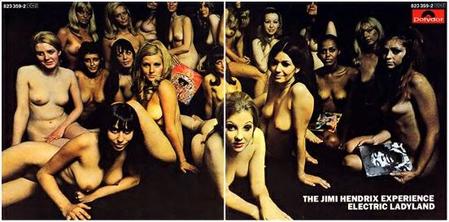
No naked ladies from the original Electric Ladyland album cover, for some reason. I remember them as being strangely unerotic: they were an odd looking bunch. Since this post was supposed to be about cars and every knows that men link cars with sex, I really should rectify the omission.
I'm now trying to remember the name and author of the book that ... Crash' - just remembered - by err ... I might have liked the book better if I'd understood what the car/sex link was. Him?Really? I think of him as a science-fiction writer.
One of the great things in driving around Poland is the ease with which you can find a hotel for the night without having to book. There are so many to choose, either directly on the roadside or clearly signposted. The quality can range from great to barely usable, but that in itself is part of the fun of travel.
A roadside hotel coffee stop, too early to stop the night.
I was therefore surprised to see a headline about a shortage of hotel beds in Poland, but it turned out to be an English language difference. Poland actually seems to be doing quite well if you consider 'hotels' to be a general term for accommodation. However, I decided to check my understanding of English.
Oxford Wordpower neatly sums up 'hotel' as "a place to stay when you are on holiday or travelling". This isn't always true for a Bed and Breakfast, but the dictionary clarifies this as "a private house which provides a room for the night" and "a place to stay in a private house or small hotel that consists of ...". The ambiguity here reflects my own first impression of a B&B in the first sense, but my recognition that the small hotel version is true as well. Other places, eg pubs also do bed and breakfast. Poland has 'B&B's, although their existence isn't recognised by Polish Wikipedia. From my stay in one in Mikołajki, where there are loads, I suspect that people don't know what it means. There was a kettle and fridge, but no food or anything provided by the people who ran the place. It didn't even merit a picture, but it was just a few doors up from this rather more up-market self catering 'B&B'.
[Oxford Wordpower is a useful English dictionary with Polish equivalents, rather than a straight forward E/P and P/E dictionary.]
This hotel had the Polish title 'zajazd', sometimes translated into English as 'inn'. Many zajazds are just restaurants. We stopped the night and the quality was fine, although we didn't try the breakfast in the rather basic, cafe bar.
'Motel' is also ambiguous for me, being foremost the US style "if you stay in a motel you can park your car near your room" (Oxford Wordpower again) famed for sexual encounters and criminal hideaways as the person at the counter doesn't see what's happening. It is also, however, just a "hotel near a main road for people who are travelling by car".
Another chance roadside stop, with the hotel (in Mrągowo) well placed for a dusk encounter. The unusual "West House" name reflects the town's hosting of an International Country Music festival although, chatting at the bar, it seems to have become a largely Polish and minimal Country affair. Mrongoville Western City is nearby, but we headed west in the morning, completely ignorant of it's existence. There seems to be lots of cowboy towns in Poland.
Although there were few details, part of the reason for thinking there was a shortage of hotels came from one of those tedious EU average comparisons. Surprisingly enough, Poland has fewer hotels that those seemingly sunshine guaranteed, Mediterranean holiday destinations, with their thousands and thousands of hotel rooms lined up in developed strips along the coast.
An English B&B in the country outside Salisbury. Having become accustomed to the ease of finding accommodation in Poland, we hadn't booked anywhere. The chain motels on the main road were full, so I took the smaller roads towards Salisbury, thinking there must be lots of places to stay. There was eventually a road sign for the B&B several miles away along an even more minor road. It was the only place that I saw. However, in the morning light I found we had passed quite a few: the signs were invisible in the evening. British tourists seem to be expected to be tucked up in bed before dark.
A problem there, frequently found in Poland as well, was that the TV didn't work. Both of these two were notable for not being plagued by that normal English problem of mildew and fungus caused by the damp walls (itself caused by lack of ventilation).
I pre-booked this B&B outside Canterbury so that I could have an assured place to stay in time for the ferry. Not only was the name "Amadis" invisible in the dark, but there was no indication that it was a B&B. Nice place though, with a wide range of international licence plates on the cars.
The Amadis B&B is owned and run by Dot and Geoff Tomaszek. Goeff's father was Polish, but he has never been to Poland.
I do have some apprehension for the future of Poland's road side hotels. Far from having a shortage of beds, many rural travel-through areas will soon find that their hotels are superfluous and disappearing. Motorways and expressways may be great for speeding the traveller to the destination of choice, but who will want to detour off the route to stop for a night in some nowhere place that might or might not have somewhere to stay?
The Zajazd shown earlier is a typical 'in the middle of nowhere' hotel, depending on passing traffic on the A22. It's future? The place already needs renovation and was for sale. On the road to oblivion?
"How amazing, He's landed better than many planes I've been on with their wheels down." "He flies gliders." Perhaps he can judge the distance better without wheels. I wonder what he lands like normally."
No disrespect meant and I assume his mates have already been pulling his leg about this.
"I feel sorry for the (TV) reporters. The text ticker at the bottom keeps reporting there are no injuries and the airport will be open at 8:00am tomorrow, but all they have to ask the reporter at the scene is 'Can you tell us about injuries and when will the airport re-open.' No wonder they make so much of disasters."
Short and sweet for a change, as I'm testing out the computer to see if I've cured a 'blue screen' problem.
For urban gardeners, Polish celebration of Halloween is perfectly timed for the cusp between autumn and winter, literally celebrating the fruits of the growing year.
Driving along the Piaseczno / Nadarzyn road you suddenly come across a group of some seven or eight stalls of bright orange pumpkins, shining out like the early morning sun, bringing a haze of colour to an otherwise drab landscape.
The road is aptly named Sunny (Słoneczna - the 721), with the pumpkin fields lying behind the houses at the front. Although it is quite common to come across a single or a pair of stalls around Warsaw, the collection on this road makes it exceptionally attractive, both in terms of looks and stopping to buy. The one we mainly used had the added advantage of having a small car park.
There is all the witch stuff and trick-or-treat for young kids and a restaurant night out for those who want it (and pubs, I guess, if you have one near you). However, it is the display of colour that I value most, surviving the frosts and giving a warm welcome, as night takes over from day and grey increasingly engulfs us in anticipation of the monotones of snow.
I didn't look around for value for money, so I don't know how fair the price is, but this lot came to 95 zloties. Very big ones at this stall were 100zl, although the quote at one of the others was 1,000zl: it may have been slightly bigger, but not much. I presume they are cheaper in the supermarkets, but I have never seen the range of colours and shapes that the growers sell by the road.
We have asked in other places in previous years whether the fruit is edible and the answer has generally been 'yes'. Not that we've actually eaten them, though.