Thursday, 3 November 2011

So Many Hotels in Poland

One of the great things in driving around Poland is the ease with which you can find a hotel for the night without having to book. There are so many to choose, either directly on the roadside or clearly signposted. The quality can range from great to barely usable, but that in itself is part of the fun of travel.

A roadside hotel coffee stop, too early to stop the night.

From 2011 08

I was therefore surprised to see a headline about a shortage of hotel beds in Poland, but it turned out to be an English language difference. Poland actually seems to be doing quite well if you consider 'hotels' to be a general term for accommodation. However, I decided to check my understanding of English.

Oxford Wordpower neatly sums up 'hotel' as "a place to stay when you are on holiday or travelling". This isn't always true for a Bed and Breakfast, but the dictionary clarifies this as "a private house which provides a room for the night" and "a place to stay in a private house or small hotel that consists of ...". The ambiguity here reflects my own first impression of a B&B in the first sense, but my recognition that the small hotel version is true as well. Other places, eg pubs also do bed and breakfast. Poland has 'B&B's, although their existence isn't recognised by Polish Wikipedia. From my stay in one in Mikołajki, where there are loads, I suspect that people don't know what it means. There was a kettle and fridge, but no food or anything provided by the people who ran the place. It didn't even merit a picture, but it was just a few doors up from this rather more up-market self catering 'B&B'.

[Oxford Wordpower is a useful English dictionary with Polish equivalents, rather than a straight forward E/P and P/E dictionary.]

This hotel had the Polish title 'zajazd', sometimes translated into English as 'inn'. Many zajazds are just restaurants. We stopped the night and the quality was fine, although we didn't try the breakfast in the rather basic, cafe bar.


'Motel' is also ambiguous for me, being foremost the US style "if you stay in a motel you can park your car near your room" (Oxford Wordpower again) famed for sexual encounters and criminal hideaways as the person at the counter doesn't see what's happening. It is also, however, just a "hotel near a main road for people who are travelling by car".

Another chance roadside stop, with the hotel (in Mrągowo) well placed for a dusk encounter. The unusual "West House" name reflects the town's hosting of an International Country Music festival although, chatting at the bar, it seems to have become a largely Polish and minimal Country affair. Mrongoville Western City is nearby, but we headed west in the morning, completely ignorant of it's existence. There seems to be lots of cowboy towns in Poland.


Although there were few details, part of the reason for thinking there was a shortage of hotels came from one of those tedious EU average comparisons. Surprisingly enough, Poland has fewer hotels that those seemingly sunshine guaranteed, Mediterranean holiday destinations, with their thousands and thousands of hotel rooms lined up in developed strips along the coast.

An English B&B in the country outside Salisbury. Having become accustomed to the ease of finding accommodation in Poland, we hadn't booked anywhere. The chain motels on the main road were full, so I took the smaller roads towards Salisbury, thinking there must be lots of places to stay. There was eventually a road sign for the B&B several miles away along an even more minor road. It was the only place that I saw. However, in the morning light I found we had passed quite a few: the signs were invisible in the evening. British tourists seem to be expected to be tucked up in bed before dark.

From 2011 07 England

A problem there, frequently found in Poland as well, was that the TV didn't work. Both of these two were notable for not being plagued by that normal English problem of mildew and fungus caused by the damp walls (itself caused by lack of ventilation).

I pre-booked this B&B outside Canterbury so that I could have an assured place to stay in time for the ferry. Not only was the name "Amadis" invisible in the dark, but there was no indication that it was a B&B. Nice place though, with a wide range of international licence plates on the cars.


The Amadis B&B is owned and run by Dot and Geoff Tomaszek. Goeff's father was Polish, but he has never been to Poland.


I do have some apprehension for the future of Poland's road side hotels. Far from having a shortage of beds, many rural travel-through areas will soon find that their hotels are superfluous and disappearing. Motorways and expressways may be great for speeding the traveller to the destination of choice, but who will want to detour off the route to stop for a night in some nowhere place that might or might not have somewhere to stay?

The Zajazd shown earlier is a typical 'in the middle of nowhere' hotel, depending on passing traffic on the A22. It's future? The place already needs renovation and was for sale. On the road to oblivion?

Wednesday, 2 November 2011

Chatter about the Warsaw no-wheel plane landing

"How amazing, He's landed better than many planes I've been on with their wheels down." "He flies gliders." Perhaps he can judge the distance better without wheels. I wonder what he lands like normally."

No disrespect meant and I assume his mates have already been pulling his leg about this.


"I feel sorry for the (TV) reporters. The text ticker at the bottom keeps reporting there are no injuries and the airport will be open at 8:00am tomorrow, but all they have to ask the reporter at the scene is 'Can you tell us about injuries and when will the airport re-open.' No wonder they make so much of disasters."

Short and sweet for a change, as I'm testing out the computer to see if I've cured a 'blue screen' problem.

Thursday, 27 October 2011

Plump Pumpkins and Gaudy Gourds

For urban gardeners, Polish celebration of Halloween is perfectly timed for the cusp between autumn and winter, literally celebrating the fruits of the growing year.

From 2011 10

Driving along the Piaseczno / Nadarzyn road you suddenly come across a group of some seven or eight stalls of bright orange pumpkins, shining out like the early morning sun, bringing a haze of colour to an otherwise drab landscape.


The road is aptly named Sunny (Słoneczna - the 721), with the pumpkin fields lying behind the houses at the front. Although it is quite common to come across a single or a pair of stalls around Warsaw, the collection on this road makes it exceptionally attractive, both in terms of looks and stopping to buy. The one we mainly used had the added advantage of having a small car park.


There is all the witch stuff and trick-or-treat for young kids and a restaurant night out for those who want it (and pubs, I guess, if you have one near you). However, it is the display of colour that I value most, surviving the frosts and giving a warm welcome, as night takes over from day and grey increasingly engulfs us in anticipation of the monotones of snow.


I didn't look around for value for money, so I don't know how fair the price is, but this lot came to 95 zloties. Very big ones at this stall were 100zl, although the quote at one of the others was 1,000zl: it may have been slightly bigger, but not much. I presume they are cheaper in the supermarkets, but I have never seen the range of colours and shapes that the growers sell by the road.

We have asked in other places in previous years whether the fruit is edible and the answer has generally been 'yes'. Not that we've actually eaten them, though.

Monday, 24 October 2011

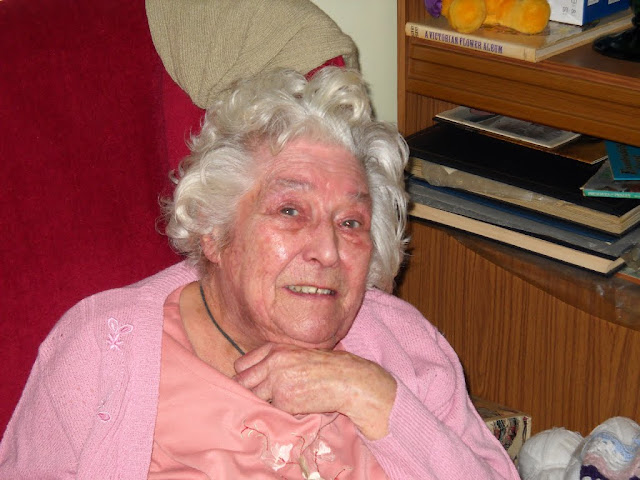
My Mum's Smile

My Mum, Stella (aka to the family as Bet), died recently. I have been trying to think how to commemorate her, but there was so much to remember and so many things I would like to say. She lives on: many of my attitudes and my perspective are derived from her, so it is a reasonable assumption that any comments I make here are likely to be in some way a reflection of her and her influence. She already has a memorial garden here in Młochów, with much I have done here inspiring thoughts of her and with the wish that she was here with me to give advice, comment or simply to enjoy everything.

However, in looking through my photographs, something more direct and personal to her came to mind: her smile (eg from 2010).

From Mum

It is so common in her photographs eg in this childhood picture with brother Jack and sister Margaret - I think it is (Great) Auntie Bun in the background.


At her wedding to Richard:


With their first son, also named Richard - Richard, the father, died around four years after this, so Mum raised their two sons by herself, still smiling:


With (Great) Uncle George, a veteran of both World Wars and a Japanese prisoner of war camp.


With Jan and Will Spayne. Mum's friendship with Jan took us on holidays we might never otherwise have had, walking in the Lake District, Wales and elsewhere.


With Uncle George again and grandson Stephen:


With brother John in 2001:


With granddaughter Misia (Michelle)in 2005:


With the waiter in her favourite Indian restaurant in 2006:


With Babcia Basia (her sister-in-law?) in 2006:


As she became increasingly ill and she could feel her time ebbing away, the smile became more difficult, but it could still be there at least as the glimmer visible in this picture with Misia again in July this year.


One of my last memories of her was in the nursing home where she was staying. She was still being prepared for our visit when we arrived, so we waited outside her room. All we could hear was peels of laughter from the support staff behind the closed door: that was my Mum, making people laugh!

Friday, 14 October 2011

Teacher's Day

For a household with a teacher, schoolgirl and her chauffeur, Teacher's Day is a special day. As Poland.pl describes it (in my English):

Teachers’ Day, officially called National Education Day, is celebrated on October 14 in Poland. The schools organise formal assemblies to honour the teachers.
 
National Education Day was introduced 28 years ago. It is the anniversary of the creation of the Commission of National Education in 1773 by King Stanisław August Poniatowski.

Teachers are given awards by their Directors and students give them flowers and gifts.

Today is special because, despite the above, school children don't go to school, which means that I didn't have the twice daily shuttle. Friday just happens to be the day in the week when everyone leaves late, though, so I didn't get an extra lie-in. That there isn't any education on National Education Day is the most important thing for the kids, but in some mysterious communal way, they did give flowers yesterday. Orchids seem to be very much in fashion at the moment.

I still had an important role to play, however. I produced a plateful of fancily arranged delicacies for the teaching staff's social networking get-together. 'Important', 'fancily' and 'delicacies' rather over egg the value of boiled eggs with garlic sauce wrapped in smoked salmon and ham (plus lettuce and tomato decoration), but at least I did do something to thank our award winning, family teaching member and her colleagues.

Thursday, 13 October 2011

The Election

There's news on the street that Poland has scored a European and, possibly, world first in the election. Yes. it's the first ever political party to get into Parliament named after a chain of cigarette shops: Ruch. (There's also a transvestite MP, apparently.)

There seems general consensus that the Ruch Palikot party will provide entertainment, although I found that many of Palikot's political antics were too full of aggressive hate to be funny even though I saw the joke. I will therefore be watching to see whether the Party will be Smokin'-hot, Cool Cats - punning his name, or will they just turn out to be Trash Can Incendiaries.

However, there are people who look to the party to present a serious political alternative. Poland calls out for you: just imagine the singer in the following video is Poland personified:

I've been looking for a driver who's qualified,
So if you think that you're the one, step into my ride.
I'm a fine-tuned supersonic speed machine
With a sunroof top and a gangster lean.

...

Shut Up and Drive
Shut Up and Drive


Did you notice the country on the car numberplate? Go on, guys, force yourself to look at the video again.

Tuesday, 11 October 2011

Butterflies in a Polish Summer

Summer had its fair share as well, but the predominance of more drabber, light brown colours and blander pale colours made it less awe inspiring. The main included the Dusky Meadow Brown - Likaon in Polish, a name from Greek mythology, I think. I can't see any connection, but great story from Encyclopedia Brittanica:

Lycaon, in Greek mythology, a legendary king of Arcadia. Traditionally, he was an impious and cruel king who tried to trick Zeus, the king of the gods, into eating human flesh. The god was not deceived and in wrath devastated the earth with Deucalian’s flood, according to Ovid’s Metamorphoses, Book I. Lycaon himself was turned into a wolf.

The story of Lycaon was apparently told in order to explain an extraordinary ceremony, the Lycaea, held in honour of Zeus Lycaeus at Mount Lycaeus. According to Plato (Republic, Book VIII), this ceremony was believed to involve human sacrifice and lycanthropy (assuming the form of a wolf). The Greek traveller Pausanias implies that the rite was still practised in the 2nd century ad.


OK, it's the Werewolf Butterfly.


Hanging around with this was the rather similarly coloured Ringlet - Trawnik in Polish, which now translates into Lawn, but I suspect that simply calling it the Grass might be closer to the original.


There were numerous white and very pale yellow butterflies, but flying along with them was the more eyecatching (Common) Brimstone - take your pick in Polish, the easiest being the Lemon (Cytrynek), but Lemon Leaf or the Summer Lemon Leaf being possibilities.


Others were far less common, such as the Small Copper, whose Polish name (Żarek) has various options, although 'Glowing Embers' sounds good to me.


Walking around the garden one day, I saw a butterfly that was much larger and differently coloured than any others, but it flew off as soon as I got close. I eventually came across it in another garden just round the corner, but again, just a quick snap and it left. It's the Old World Swallowtail - The King's Page (in the sense of Pageboy, rather than a piece of paper) in Polish: Paź królowej.


I would have no chance of identifying many of these without having my photographs and then being able to compare with my reference books. I nearly gave up on this one, but fortunately I had both upper and lower wings pictures. It's (fingers crossed) the Silver Washed Fritillary or the Raspberry Mother-of-Pearl in Polish (Perłowiec Malinowiec).


It was the under-wing that eventually decided me thanks to my 1989 Observers Butterflies, as my 1972 Mały Atlas Motyli only has top-wing illustrations. (When you take lots of photos, there must be times when near-perfect results happen by complete accident.)


I saw the Marbled White a few times in the garden, but it was around the corner again that I got a slightly better photo. "Chessboard' in Polish - Szachownica.


This last doesn't appear in Observers Butterflies, but is the summer colours of Kratnik (The Lattice) in Mały Atlas Motyli. Wikipedia (regularly referred to in trying to find out these names) tells me it's called the Map in English and that "In the UK this species is a very rare vagrant, but there have also been several unsuccessful – and now illegal – attempts at introducing this species over the past 100 years or so". Its common in Poland. This is another picture from outside the garden and I am not sure if I saw it there at all.