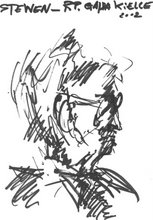
I took up the idea of creating English lyrics for Perfect's Autobiography following Pacze Moj's first post with video and second post with progressing versions. I've managed to complete something, which while far from perfect, I reckon deserves a C+ for effort. How did the original go again?
What I've tried to do is create 'sing along to the original' lyrics that give the right flavour to the song. The result is:
I was only ten:
We first heard about him then;
In my basement we made our club.
My pal's radio played:
Our first hearing 'Blue Suede Shoes'
And I couldn't sleep that night.
The changing wind it blew,
Those imprisoned were set free:
Once again, we laughed and joked.
Café’s buzzing scene,
Like tornadoes, jazz blew clean:
Just to play,
That was my right.
Father, God only knows,
Why our factory he did close.
Me? My finger nail came off,
Shaving fretted my throat,
Playing loads of magic? Nope!
And I found the thrill of sex.
Music Postcard craze,
Found five hundred in those days;
Didn't get a new pair of jeans.
And come Saturday night,
Luxembourg, a cabin, drink:
Oh, how much,
We wanted life!
There were us three.
Though in our blood we were free,
But with one overwhelming goal:
In several years,
Have the world at our heels,
Grind it down in the dirt.
Alpaga plonk,
And discussions 'til dawn,
Our wakened spirits never able to rest.
Who punched whose nose?
And then tears for this flowed:
Things happening.
Separated us,
Perfect Pola Raska's face;
All ready to die for this.
On a summer night,
On a blanket in moonlight,
What I wanted then, I found.
She said quick to me that our problems they might come.
I said I worked for my exam;
She turned up the heat.
After some time, we don't meet.
Once again,
Me alone.
New faces I claim
To mask out my pain.
Life taught me much more than they did.
Dossed on the floor,
Just killing off time.
Our greatest time
Pub visit for cheers,
Klezmer asked me to play;
So much rubbish that still I go red.
One certain day,
Figured out that I knew:
Nothing at all.
Hearing my past,
Overcoming at last
Coming real then was my greatest dream:
The thousandth crowd,
Drinking words from my mouth,
All loving me.
A hotel, a fan,
Saying "recorder I ran
That's just how a real throat should sing".
I open the door,
Saying nothing at all:
Blank walls never can
It reads pretty awfully, but many song lyrics do. So how does it sound? Here's an enhanced lektor style video of a nearly completed version: you can see work in progress if you look closely.
Given that I am trying to translate a song between languages that have little equivalence in word syllables; where word and sentence stress is different; and where, as in this song, natural sentence structure can be very different, I forgive myself the strange English. Some explanations, however.
My lines: "Father, God only knows, why our factory he did close", comes from the original lines "Father, God only knows, where he put the Martenowski (open hearth) furnace". I have interpreted this as a reference to the furnaces being built in Poland, but through some distant decision making process, not installed here. It is therefore a complaint about economic failure. My reference to factory closure is intended to reflect this, but makes it accessible to a foreign audience. It adds a touch of irony related to the modern situation, where factories are moved to Poland. Other interpretations I immediately think of are: Martenowski was also slang for a domestic heater of some sort, which no one could find after Dad put it away (although I have found no internet reference to this slang); or it asks why Dad has lost his red hot, fiery enthusiasm. My interpretation could therefore be completely wrong even in its intention. Is the direct relationship of 'Father' and 'God' obvious in Polish eg from the Pope being Father of the World?
I would have translated "Klezmer asked me to play", as "Busker asked me to play", but Kompas Translator has an excellent English dictionary. Webster's Third New International [English] Directory tells me Klezmer is "a Jewish instrumentalist; a member of a band of folk musicians in Eastern Europe hired to play at Jewish weddings and gatherings". I intend it to sound like a name in the song, but it is a hidden reference to Poland's cultural past. I wonder if Perfect (or Bogdan Olewicz, who seems to have written the words) knew about this?
Since use of English seems to be quite fashionable at the moment, perhaps Perfect would like to put it on their next album. Obviously, I claim full money grabbing rights - OK, Pacze Moj may deserve a couple of quid too.
Wednesday, 13 April 2011


Monday, 11 April 2011
Bop Around the Mop
It was a dull, depressing day when it occurred to me that I hadn't looked at the music downloads at Wirtualna Polska's MP3 download site for ages. I headed for the electronic dance music section, since this kind of music is fun to bop around the house to when doing washing and polishing the floors - even the hoovering for that matter.
The first I came across was Beattraax (Beat Tracks, if you hadn't noticed). He is a producer, composer and DJ from Opole and this is one of his many downloadable tracks: DRiFT (Side B Drunk Remix).

He appears to be very active on the club scene. See also his website (in English) for downloads. This is a video from the WP site.
I simply downloaded a few year's worth and then deleted those (the majority, but there are lots and lots) that I didn't like. I was still left with 16 tracks that I can twitch to. This is a collaboration with another DJ, e-Bonit, with French Kiss, DJ Zizi Remix.
A different version on video:
e-Bonit also has a WP site, with plenty to download. I must admit that I found many of his recordings rather plodding, but there were some I kept. There's a link to his website, but his hoster is off line at the moment. When/If it comes back, you will see how tiny some Polish clubs are - a small party atmosphere. This is his extended mix of B-QLL's 'Go Baby Go' - Polish rapping with an English catch line.

You can spend months going through the WP site, but this time I only added DJ Walus (he who is not the walrus) - I don't even know if his name is pronounced Valus, rhyming with 'loose' or maybe 'phallus'. Not that it matters, as he is now called Lambretto. His 'Dance With Me, My Baby' is next.

I am hoping that all this is legal, as the tracks are freely available. See also DJ Vitek's site, which says something along the lines of: The site makes available music of lower sound quality for the purpose of popularising the authors and to encourage users to purchase the original source CD containing the music of the performers, in accordance with the law on copyright of 1 August 2000. On the promotion of most Polish performers, we have agreement or links to the WP site. If links in any way infringe copyright, they will be immediately removed on receipt of a reliable application. Whilst I am not sure that I fit in with the letter of this description, I am pretty sure that I come more within the spirit of it than his many downloads.
The first I came across was Beattraax (Beat Tracks, if you hadn't noticed). He is a producer, composer and DJ from Opole and this is one of his many downloadable tracks: DRiFT (Side B Drunk Remix).
He appears to be very active on the club scene. See also his website (in English) for downloads. This is a video from the WP site.
I simply downloaded a few year's worth and then deleted those (the majority, but there are lots and lots) that I didn't like. I was still left with 16 tracks that I can twitch to. This is a collaboration with another DJ, e-Bonit, with French Kiss, DJ Zizi Remix.
A different version on video:
e-Bonit also has a WP site, with plenty to download. I must admit that I found many of his recordings rather plodding, but there were some I kept. There's a link to his website, but his hoster is off line at the moment. When/If it comes back, you will see how tiny some Polish clubs are - a small party atmosphere. This is his extended mix of B-QLL's 'Go Baby Go' - Polish rapping with an English catch line.
You can spend months going through the WP site, but this time I only added DJ Walus (he who is not the walrus) - I don't even know if his name is pronounced Valus, rhyming with 'loose' or maybe 'phallus'. Not that it matters, as he is now called Lambretto. His 'Dance With Me, My Baby' is next.
I am hoping that all this is legal, as the tracks are freely available. See also DJ Vitek's site, which says something along the lines of: The site makes available music of lower sound quality for the purpose of popularising the authors and to encourage users to purchase the original source CD containing the music of the performers, in accordance with the law on copyright of 1 August 2000. On the promotion of most Polish performers, we have agreement or links to the WP site. If links in any way infringe copyright, they will be immediately removed on receipt of a reliable application. Whilst I am not sure that I fit in with the letter of this description, I am pretty sure that I come more within the spirit of it than his many downloads.
Tuesday, 5 April 2011
It takes Two to Tango
It's tractor season.
Taking Misia to school this morning, there were two tractors working in tandem in one field, whilst another was working alone in another. By the time I got back, one of the pair had separated ...

Soon after, moving back to join its partner. Life's a Tango.

Not every one has a partner,

But then on the horizon, someone appears,

Moves close enough to touch,

But goes straight past.

Then stops, watching the dancers.

I had the tango on my mind. Pacze Moj has set himself the task of correctly translating a Polish song into a rhythmically rhymed version, which must be pretty impossible. I wish him luck. Actually, I want to give it a try when I have time, but it will be more an attempt at interpretation rather than translation: I want to bring out some of the emotions resulting from the cultural context, which would have little literal impact on a foreign audience.
Some texts - songs, poems, books - are probably untranslatable. Listening to music whilst painting the hall, an example came on. Laurie Anderson's 'It Tango', from her first, 'Big Science' album.
The words were fascinating, with the ambiguity of 'just' immediately hitting me: "just like a woman" meaning both "typical of a woman" and "fair and reasonable like a woman". The use of the word 'it' also seems to be used ambiguously, being both non-substantial - "It's just like a a woman" - and specific - "It's hard", although exactly what 'it' is, is unclear. Maybe life's just and hard: "Life Tango". There's lots of other nuances, which reading the words - my understanding of them is shown below - may actually hide.
She said:
It looks.
Don't you think it looks a lot like rain?
He said:
Isn't it?
Isn't it just?
Isn't it just like a woman?
She said:
It's hard.
It's just hard.
It's just kind of hard to say.
He said:
Isn't it.
Isn't it just.
Isn't it just like a woman?
She said:
It goes.
That's the way it goes.
It goes that way.
He said:
Isn't it.
Isn't it just like a woman?
She said:
It takes.
It takes one.
It takes - one, two -
It takes one to know one.
He said:
Isn't it just like a woman?
She said ...
She said it.
She said it to know.
She said it to no one.
Isn't it.
Isn't it just?
Isn't it just like a woman?
You're I.
It's a day's work,
To look into them.
Your eyes.
It's a day's work
Just
Looking in to them.
I think the rhythm works as a tango, but the only one I really know is from the film, Scent of a Woman.
The plot of the film helps creates the feeling of two ordinary people dancing rather than anything virtuoso, but this is the real thing.
Strange though, I had the idea that tango dancers, separated and came together again, with that being the reason why there are so many references to life being a tango. So what is tango?
Taking Misia to school this morning, there were two tractors working in tandem in one field, whilst another was working alone in another. By the time I got back, one of the pair had separated ...
Soon after, moving back to join its partner. Life's a Tango.
Not every one has a partner,
But then on the horizon, someone appears,
Moves close enough to touch,
But goes straight past.
Then stops, watching the dancers.
I had the tango on my mind. Pacze Moj has set himself the task of correctly translating a Polish song into a rhythmically rhymed version, which must be pretty impossible. I wish him luck. Actually, I want to give it a try when I have time, but it will be more an attempt at interpretation rather than translation: I want to bring out some of the emotions resulting from the cultural context, which would have little literal impact on a foreign audience.
Some texts - songs, poems, books - are probably untranslatable. Listening to music whilst painting the hall, an example came on. Laurie Anderson's 'It Tango', from her first, 'Big Science' album.
The words were fascinating, with the ambiguity of 'just' immediately hitting me: "just like a woman" meaning both "typical of a woman" and "fair and reasonable like a woman". The use of the word 'it' also seems to be used ambiguously, being both non-substantial - "It's just like a a woman" - and specific - "It's hard", although exactly what 'it' is, is unclear. Maybe life's just and hard: "Life Tango". There's lots of other nuances, which reading the words - my understanding of them is shown below - may actually hide.
She said:
It looks.
Don't you think it looks a lot like rain?
He said:
Isn't it?
Isn't it just?
Isn't it just like a woman?
She said:
It's hard.
It's just hard.
It's just kind of hard to say.
He said:
Isn't it.
Isn't it just.
Isn't it just like a woman?
She said:
It goes.
That's the way it goes.
It goes that way.
He said:
Isn't it.
Isn't it just like a woman?
She said:
It takes.
It takes one.
It takes - one, two -
It takes one to know one.
He said:
Isn't it just like a woman?
She said ...
She said it.
She said it to know.
She said it to no one.
Isn't it.
Isn't it just?
Isn't it just like a woman?
You're I.
It's a day's work,
To look into them.
Your eyes.
It's a day's work
Just
Looking in to them.
I think the rhythm works as a tango, but the only one I really know is from the film, Scent of a Woman.
The plot of the film helps creates the feeling of two ordinary people dancing rather than anything virtuoso, but this is the real thing.
Strange though, I had the idea that tango dancers, separated and came together again, with that being the reason why there are so many references to life being a tango. So what is tango?
Monday, 28 March 2011
It's Spring Again (and again, and again)
It's like they don't actually want spring to come. We've had spring weather, spring plants, the astrological/astronomical first day of spring and the clocks have turned back. I then heard that in Poland spring is traditionally here when the Boczan (Bochan - Cranes) arrive.
I thought I saw a couple flying across on Saturday, but I wasn't sure. Out with Mika, the dog this morning, however:

Not the greatest of pictures, but there were three together to the left feeding together in the field.

These flew off, leaving the two to the right, walking away from me as quickly, it seemed, as I was walking to them.

The first wild flowers - dandelions - are now in full bloom.

Still, there's one last hurdle to cross. It is also traditional, I am told, to go out at Easter and see if the willow are in bloom. Easter's late this year anyway, but they've been out for a few weeks now.

What will the weather presenters think of next?
I thought I saw a couple flying across on Saturday, but I wasn't sure. Out with Mika, the dog this morning, however:
Not the greatest of pictures, but there were three together to the left feeding together in the field.
These flew off, leaving the two to the right, walking away from me as quickly, it seemed, as I was walking to them.
The first wild flowers - dandelions - are now in full bloom.
Still, there's one last hurdle to cross. It is also traditional, I am told, to go out at Easter and see if the willow are in bloom. Easter's late this year anyway, but they've been out for a few weeks now.
What will the weather presenters think of next?
Sunday, 27 March 2011
Tourism Promotion
Promoting your town, country, etc to foreigners is fraught with many dangers. One of these is that what is obviously an important feature to you, may actually be off-putting to the foreign tourist. The following aren't tourism promotion, but they contain features that are sometimes very similar. Which one would attract you?
I was looking for information on the Lusatian Culture on Yahoo, England and came across wn.com/West_Slavs, which has various privately made Slavic and Polish related videos. The first was an informational film on coming to Poland.
All very well, but my basic reaction was that it emphasised the difficulty of understanding Polish. Its well-meaning and seems to be intended for people who are committed to coming here, but it would have convinced me that there must be better places to go.
The next video extolled the virtues of the Slavic peoples.
I must be the wrong generation, as with just a few changes, this would have made a good propaganda film for Hegel and Hitler in their promotion of the concept of the German Master race: a bit, scary, actually.
Maybe the next might be more effective.
This has the obvious tourist promotional failure of alienating a huge swath of the tourist market. It's a very simple summary of the reason why I'm here.

There are links to lots of related videos at the end of the ones above. This one shows the extraordinary recent impact of Polish people on residents and visitors to Stirling in Scotland. I wonder how many, if any, of these people would even have heard a word of Polish ten years ago.
This is actually the best advert for Poland as far as I'm concerned (if I had never been here). I'd immediately want to know more about the people and country that had had such an influence. The only slightly negative element being the Polish commentator's accent, but I'm biased by experience and assume that, if I'd never been here, I'd take comfort in knowing that Polish people do speak English (of a sorts).
This last is the original Lusatian Culture video, which is here just so that I don't loose it. It's all Slavic Master Race stuff. If you're interested, you might like to look at Wikipedia on the Vistula Veneti, which provides better starting background. I'm still trying to understand what these people were like - they lived (or at least were buried) in Młochów. Racial issues are not very important to me.
I was looking for information on the Lusatian Culture on Yahoo, England and came across wn.com/West_Slavs, which has various privately made Slavic and Polish related videos. The first was an informational film on coming to Poland.
All very well, but my basic reaction was that it emphasised the difficulty of understanding Polish. Its well-meaning and seems to be intended for people who are committed to coming here, but it would have convinced me that there must be better places to go.
The next video extolled the virtues of the Slavic peoples.
I must be the wrong generation, as with just a few changes, this would have made a good propaganda film for Hegel and Hitler in their promotion of the concept of the German Master race: a bit, scary, actually.
Maybe the next might be more effective.
This has the obvious tourist promotional failure of alienating a huge swath of the tourist market. It's a very simple summary of the reason why I'm here.
There are links to lots of related videos at the end of the ones above. This one shows the extraordinary recent impact of Polish people on residents and visitors to Stirling in Scotland. I wonder how many, if any, of these people would even have heard a word of Polish ten years ago.
This is actually the best advert for Poland as far as I'm concerned (if I had never been here). I'd immediately want to know more about the people and country that had had such an influence. The only slightly negative element being the Polish commentator's accent, but I'm biased by experience and assume that, if I'd never been here, I'd take comfort in knowing that Polish people do speak English (of a sorts).
This last is the original Lusatian Culture video, which is here just so that I don't loose it. It's all Slavic Master Race stuff. If you're interested, you might like to look at Wikipedia on the Vistula Veneti, which provides better starting background. I'm still trying to understand what these people were like - they lived (or at least were buried) in Młochów. Racial issues are not very important to me.
Saturday, 26 March 2011
To Be (a Kebab) or not to Be
A couple of days ago, Babcia said our local shop has complete and absolute rubbish. At least I think that's what she meant: the actual word - pronounced goovno - usually has rather more faecal implication, but she often seems not to consider such connotations.

(The snow isn't from today, but it may well have looked like the same after this morning's snow.)
Babcia's right, but only from her life-time experience of walking down to the local bazaar to get today's cheap, traditional fresh Polish dinner. An alternative way of putting it is that it is well suited to being a single local village shop in a car and supermarket world. It has no short walking distance competition - isn't doesn't even need a name, so it is expensive, but has a good range for immediate, essential purchase needs. It is not intended for buying Babcia's meals.
A recent addition caught me by surprise, however: a list of burgers, hot-dog and kebab. They don't have any food heating facilities and I couldn't see anything on display, so I didn't know what they were like. I tried the kebab.

They were in the bottom of the food fridge, but I couldn't have recognised them. They looked like small round loaves of bread - about 20 cm/8in across. At 8.50 zloties, they sounded expensive, but they were large. What could they possible be like inside?

I still couldn't recognise the 'kebab'. I heated a third of it - about the size of a medium burger - for a minute in the microwave. The inside was more like a spicy Chinese/Vietnamese dish. It had real chicken pieces and a fully acceptable mild chilli-pepper flavour. Most surprisingly, it balanced well with the bread surround, not at all appearing to be a loaf with a small amount of jam doughnut equivalent filling. Pleasant enough even to be an acceptable dish eaten with rice - not even a hint of sweetening. Not really my choice, especially since it was large enough for three meals, but well thought out and delivered. In fact, although I can see the marketing value of calling it a kebab, it really deserves its own name. Good luck to the producer.
Still, it was such a fundamental difference to the shop's normal range, that I wondered if they would sell enough to be worth stocking. Now, three weeks later, the list is still there and more kebabs, at least, were in the fridge yesterday. There must be a demand and I can imagine them becoming standard food for the many seasonal building workers that come here, rivalling even bottled Breton Beans (Fasolka po Bretońsku). (The shop gets crowded when they arrive and the beer fridge empties.)

From Slim Line: "Breton beans is a quick and easy-to-prepare idea for lunch. An additional advantage is that it's low fat and low in calories. Therefore, this product is recommended for those on a diet". Not quite the thing for manual labour, maybe, but it's one of the few ready prepared meals available to them and preferred to the other bottled meals. They can even manage to heat it up with just an automatic kettle, putting the bottle into the water when it has boiled and leaving it to warm.
I buy them - preferably with just sausage (kiełbasa) rather than with boczek (bochek - fatty, streaky bacon in lumps). They make a standby meal that can stay in the larder for ages. Tesco regularly has promotions with reduced prices or with genuinely 'no extra cost' extra quantity. Not the greatest food - I normally add chilli, but convenient. Some more traditional Polish restaurants make much higher quality versions.
I said the shop was expensive, but not as expensive as others seem to be: "Jaroslaw Kaczynski went to a local grocery shop and bought potatoes, flour, chicken, apples and sugar. The shopping cost 55.60 zloties". Maybe he was preparing a banquet for himself (and his Mum?).
(The snow isn't from today, but it may well have looked like the same after this morning's snow.)
Babcia's right, but only from her life-time experience of walking down to the local bazaar to get today's cheap, traditional fresh Polish dinner. An alternative way of putting it is that it is well suited to being a single local village shop in a car and supermarket world. It has no short walking distance competition - isn't doesn't even need a name, so it is expensive, but has a good range for immediate, essential purchase needs. It is not intended for buying Babcia's meals.
A recent addition caught me by surprise, however: a list of burgers, hot-dog and kebab. They don't have any food heating facilities and I couldn't see anything on display, so I didn't know what they were like. I tried the kebab.
They were in the bottom of the food fridge, but I couldn't have recognised them. They looked like small round loaves of bread - about 20 cm/8in across. At 8.50 zloties, they sounded expensive, but they were large. What could they possible be like inside?
I still couldn't recognise the 'kebab'. I heated a third of it - about the size of a medium burger - for a minute in the microwave. The inside was more like a spicy Chinese/Vietnamese dish. It had real chicken pieces and a fully acceptable mild chilli-pepper flavour. Most surprisingly, it balanced well with the bread surround, not at all appearing to be a loaf with a small amount of jam doughnut equivalent filling. Pleasant enough even to be an acceptable dish eaten with rice - not even a hint of sweetening. Not really my choice, especially since it was large enough for three meals, but well thought out and delivered. In fact, although I can see the marketing value of calling it a kebab, it really deserves its own name. Good luck to the producer.
Still, it was such a fundamental difference to the shop's normal range, that I wondered if they would sell enough to be worth stocking. Now, three weeks later, the list is still there and more kebabs, at least, were in the fridge yesterday. There must be a demand and I can imagine them becoming standard food for the many seasonal building workers that come here, rivalling even bottled Breton Beans (Fasolka po Bretońsku). (The shop gets crowded when they arrive and the beer fridge empties.)
From Slim Line: "Breton beans is a quick and easy-to-prepare idea for lunch. An additional advantage is that it's low fat and low in calories. Therefore, this product is recommended for those on a diet". Not quite the thing for manual labour, maybe, but it's one of the few ready prepared meals available to them and preferred to the other bottled meals. They can even manage to heat it up with just an automatic kettle, putting the bottle into the water when it has boiled and leaving it to warm.
I buy them - preferably with just sausage (kiełbasa) rather than with boczek (bochek - fatty, streaky bacon in lumps). They make a standby meal that can stay in the larder for ages. Tesco regularly has promotions with reduced prices or with genuinely 'no extra cost' extra quantity. Not the greatest food - I normally add chilli, but convenient. Some more traditional Polish restaurants make much higher quality versions.
I said the shop was expensive, but not as expensive as others seem to be: "Jaroslaw Kaczynski went to a local grocery shop and bought potatoes, flour, chicken, apples and sugar. The shopping cost 55.60 zloties". Maybe he was preparing a banquet for himself (and his Mum?).
Thursday, 24 March 2011
Spring: Flowers and Birds
The first crocus flowered back on 12 March and have been increasing in number ever since.

The ones in flower are almost all outside the dining room window - the warmest and sunniest place in the garden.

They look best when they open in the sun, but this can also make the bright colours difficult to photograph.

Many other plants are growing strongly now, such as the Kent Bells below.

Starlings - Polish name Szpaki (Shpakee) - are constantly around feeding off insects, whatever in the gardens.

They dig into the ground, leaving small holes everywhere.

They are very nervous and whirl off at the slightest disturbance.

A couple of weeks ago, the crows - Gawrony (Gavronee) were flocking around, although they didn't come into the garden and I now normally see them flying round in pairs or small groups.

The ones in flower are almost all outside the dining room window - the warmest and sunniest place in the garden.
They look best when they open in the sun, but this can also make the bright colours difficult to photograph.
Many other plants are growing strongly now, such as the Kent Bells below.
Starlings - Polish name Szpaki (Shpakee) - are constantly around feeding off insects, whatever in the gardens.
They dig into the ground, leaving small holes everywhere.
They are very nervous and whirl off at the slightest disturbance.
A couple of weeks ago, the crows - Gawrony (Gavronee) were flocking around, although they didn't come into the garden and I now normally see them flying round in pairs or small groups.
Subscribe to:
Posts (Atom)