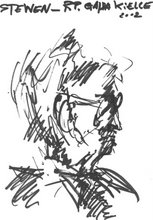
I suspected that many of the much celebrated Wikileaks revelations would be trivial, misleading parts of wider discussions and/or ambiguous in their meaning. I also expected newspapers to distort them even further. I have not bothered to follow the scandalous revelations, however, and I did see one summary from thenews.pl that I found quite interesting, as it shows that the Polish government over-reacted to a (non-existent?) snub by French President Sarkozy.
I thought, therefore, that I would do some of my own manipulation based on a CNN article containing a number of Kaczynski quotes that I found via Inside Poland. Which Kaczynski? Don't try to allocate different quotes between Lech and Jarosław, as they all come from just one person. Here they are:
"I don't get delusions and so on and so forth. I mean, I had very serious problems with social adjustment in adolescence, and a lot of people would call this a sickness. But it would have to be distinguished between an organic illness, like schizophrenia or something like that."
His brother was jealous "over the fact that our parents valued me more highly."
"I believe in nothing".
"My motive for doing what I am going to do is simply personal revenge."
No idea? An additional clue: he doesn't have a birthmark on his face. If you're still not sure, see the CNN article.
Sunday, 5 December 2010


Weasal and Mouse, RIP
The constant coming and going of birds directly in front of the kitchen and dining room windows is a constant source of wonderment. A pair of blackbirds and large numbers of sparrows, rather than just one or two, have been new sights over the last week.
Yesterday, however, there was especial excitement, with the arrival of a weasel.

I have seen weasels quite a few times around the area, but they have been little more than shapes rushing across the open before diving into the undergrowth. Looking out of the window and seeing one standing there was completely unexpected. I just had time to get the camera and take a couple of immediate shots before it hid - hence the blurred pictures.

I'm pretty sure its a Least Weasel, as Wikipedia calls it, rather than a stoat, which is very rare, although a picture in the Wikipedia entry for that is similar to the first picture above. Although both of these entries say that they turn white in snowy areas, I gather that this generally follows about 40 days of snow.
Two days before, we had had a different visitor below the bird table.

A little field mouse dug a hole and was enjoying the bird food I had scattered on the ground.


How sweet? I must admit, however, they got into the house last winter and caused the normal commotion, so their arrival was not such a surprise.
It may no longer be with us, though. We saw the weasel a bit later yesterday with a mouse in his mouth. Maybe a different mouse, of course.
Yesterday, however, there was especial excitement, with the arrival of a weasel.
I have seen weasels quite a few times around the area, but they have been little more than shapes rushing across the open before diving into the undergrowth. Looking out of the window and seeing one standing there was completely unexpected. I just had time to get the camera and take a couple of immediate shots before it hid - hence the blurred pictures.
I'm pretty sure its a Least Weasel, as Wikipedia calls it, rather than a stoat, which is very rare, although a picture in the Wikipedia entry for that is similar to the first picture above. Although both of these entries say that they turn white in snowy areas, I gather that this generally follows about 40 days of snow.
Two days before, we had had a different visitor below the bird table.
A little field mouse dug a hole and was enjoying the bird food I had scattered on the ground.
How sweet? I must admit, however, they got into the house last winter and caused the normal commotion, so their arrival was not such a surprise.
It may no longer be with us, though. We saw the weasel a bit later yesterday with a mouse in his mouth. Maybe a different mouse, of course.
Friday, 3 December 2010
Annoyance at Polish English
I saw a reference in Polish Market to an article entitled Regional disparities and growth poles in Poland . This sounded interesting.
For some background, I worked on regional policy in Poland with Piotr Żuber (Peter Bison or Peter Buffalo), architect of Polish regional policy. (Picture from Śląski University website.)

Sadly, since he is a professional civil servant and not a politician, his name is unlikely to mean anything to you. He is currently Director responsible for Co-ordination of Structural Policy in the Ministry of Regional Development and has roughly had this role from the time when EU structural policy first became a practical issue.
So, the article sounded great, but the way it is written has made it too difficult for me to read. The English itself isn't great, but I could probably cope with that. It is purely the layout, with a huge amount of text that quickly becomes impenetrable.
I would normally first skim through the text to get a quick idea of what it's about. The English style of creating paragraphs dealing with different themes is ideally suited for this. A few keywords from each paragraph tells me roughly what everything is about in a few seconds. I cannot do that here.
Breaking the text down into succinct paragraphs also assists me when I break away from the text to think about it. I know when I can take a pause from reading and I can return to where I have finished quite easily. Writing in this style, I am also forced to consider the coherence of the text, dramatically increasing my focus on the points I want to make.
I have rewritten the first eight lines of the second paragraph in my own style to show what 'paragraph thinking' does, particularly through the need to ask "what point am I trying to make here?".
The choice between national competitiveness and territorial cohesion is the main dilemma of regional policy. Measures aiming at equalising levels of development across the country often have an anti-growth character at national level. Quite simply, resources are directed away from primary growth centres to those with lesser potential. However, persistence of large regional disparities is one of the reasons why constraints on rapid growth, such as increasing costs of labour and real estate, are difficult to overcome. These ultimately slow the development of growth centres themselves. Most of the best developed and richest economies of Europe like Sweden, Finland, Denmark, Netherlands, Germany, Ireland and Italy have moderate regional disparities. Regional policies should therefore target improving conditions for development in poorer regions, such as improvement of infrastructure, education and mechanisms for transferring knowledge out from the growth centres. These will make the spread of growth easier.
Comparing this with the original, I am forced to rethink the free flow of ideas and to establish a coherent point, radically reordering the sentence to do this.
Elżbieta Wojnicka's message is now much clearer to me. It reminds me of a discussion we had with Piotr contemplating the idea of focusing EU money on areas with the greatest growth potential. The idea was purely academic - Polish political sentiment and the EU Commission would not have permitted it, but we all thought this would maximise national growth in Poland. Indeed, reinforcement of 'growth poles' would by itself increase development potential of other areas most effectively, both through inevitable leakage effects and, contrary to Dr Wojnicka's assertion, increased attractiveness over time in terms of resource costs (wages, land, etc). Spreading EU money thinly across the whole country made little sense. Instead, development money should be redirected over time to reinforce these market affects. From a purely national perspective, EU funding is heavily social rather than economic policy. There is nothing wrong with that, but it should be recognised.
Ultimately, however, I have to question my personal capabilities. Would a Polish person have little difficulty in understanding something I find completely impenetrable? It wouldn't surprise me. Indeed, close to the end - easy to jump to, Dr Wojnicka writes:
The conclusion is that the growth of regional differences in GDP level is interconnected with quick economic growth on the domestic level but after catching up in terms of income countries should aim at moderate regional divergence which is the characteristic of most of the best developed countries.
I'm not going to try and found out how she gets to that conclusion, though.
For some background, I worked on regional policy in Poland with Piotr Żuber (Peter Bison or Peter Buffalo), architect of Polish regional policy. (Picture from Śląski University website.)
Sadly, since he is a professional civil servant and not a politician, his name is unlikely to mean anything to you. He is currently Director responsible for Co-ordination of Structural Policy in the Ministry of Regional Development and has roughly had this role from the time when EU structural policy first became a practical issue.
So, the article sounded great, but the way it is written has made it too difficult for me to read. The English itself isn't great, but I could probably cope with that. It is purely the layout, with a huge amount of text that quickly becomes impenetrable.
I would normally first skim through the text to get a quick idea of what it's about. The English style of creating paragraphs dealing with different themes is ideally suited for this. A few keywords from each paragraph tells me roughly what everything is about in a few seconds. I cannot do that here.
Breaking the text down into succinct paragraphs also assists me when I break away from the text to think about it. I know when I can take a pause from reading and I can return to where I have finished quite easily. Writing in this style, I am also forced to consider the coherence of the text, dramatically increasing my focus on the points I want to make.
I have rewritten the first eight lines of the second paragraph in my own style to show what 'paragraph thinking' does, particularly through the need to ask "what point am I trying to make here?".
The choice between national competitiveness and territorial cohesion is the main dilemma of regional policy. Measures aiming at equalising levels of development across the country often have an anti-growth character at national level. Quite simply, resources are directed away from primary growth centres to those with lesser potential. However, persistence of large regional disparities is one of the reasons why constraints on rapid growth, such as increasing costs of labour and real estate, are difficult to overcome. These ultimately slow the development of growth centres themselves. Most of the best developed and richest economies of Europe like Sweden, Finland, Denmark, Netherlands, Germany, Ireland and Italy have moderate regional disparities. Regional policies should therefore target improving conditions for development in poorer regions, such as improvement of infrastructure, education and mechanisms for transferring knowledge out from the growth centres. These will make the spread of growth easier.
Comparing this with the original, I am forced to rethink the free flow of ideas and to establish a coherent point, radically reordering the sentence to do this.
Elżbieta Wojnicka's message is now much clearer to me. It reminds me of a discussion we had with Piotr contemplating the idea of focusing EU money on areas with the greatest growth potential. The idea was purely academic - Polish political sentiment and the EU Commission would not have permitted it, but we all thought this would maximise national growth in Poland. Indeed, reinforcement of 'growth poles' would by itself increase development potential of other areas most effectively, both through inevitable leakage effects and, contrary to Dr Wojnicka's assertion, increased attractiveness over time in terms of resource costs (wages, land, etc). Spreading EU money thinly across the whole country made little sense. Instead, development money should be redirected over time to reinforce these market affects. From a purely national perspective, EU funding is heavily social rather than economic policy. There is nothing wrong with that, but it should be recognised.
Ultimately, however, I have to question my personal capabilities. Would a Polish person have little difficulty in understanding something I find completely impenetrable? It wouldn't surprise me. Indeed, close to the end - easy to jump to, Dr Wojnicka writes:
The conclusion is that the growth of regional differences in GDP level is interconnected with quick economic growth on the domestic level but after catching up in terms of income countries should aim at moderate regional divergence which is the characteristic of most of the best developed countries.
I'm not going to try and found out how she gets to that conclusion, though.
Wednesday, 1 December 2010
Was Columbus Polish?
"... and again ... and again": I have to wrench myself away from writing about the snow - 20-30cm cleared and -22c in the night. So, something a bit more light hearted.
I read an article originating from MailOnline "Christopher Colombus 'was Polish not Portuguese': Historians claim explorer was son of exiled King Vladislav III". The arguments set out in the article show:
"the only way Columbus persuaded the King of Spain to fund his journey across the Atlantic Ocean was because he was royalty himself. He hid the true identity of his Polish biological father from most people". "Columbus is guilty of huge fraud carried out over two decades against his patrons".
This apparently self-contradictory description - got support because he was royalty, but defrauded his patrons by hiding the fact - rather undermines the story, but I looked at Polish Wikipedia's article on Władysław III Warneńczyk to check his family tree: no children at all. The theory was therefore an interesting development to Władysław's own story. Well, fine, but nothing really to write home about.
I later remembered that at least one Polish king was reputed to be homosexual. Could it have been Władysław? I found confirmation in the Nonsensopedia Polish Encyclopaedia of Humour article on the King. So, if he was the feminine partner of Columbus's father, Domenico Columbo, Władysław could then be described as Columbus's mother. Columbus is then both son of the Polish king, as the new theory claims, whilst Domenico Columbo was his father, as he claimed. Sorted!
I have to credit The Birdcage, a film regularly appearing on MGM (or maybe TCM) TV channel at the moment for this arrant piece of nonsense. Oh dear, I may have committed my standard sin of failing to show the proper respect for Polish historical figures. It's just a bit of silly fun - I'm not serious.
The reference to Władisław's homosexuality is also in the Polish Wikipedia article, although the English version merely suggests he may have been sexually deviant. Maybe homosexuality is thought a bit too strong an imprecation for foreign audiences. Mind you, my quick reading of the quote in Nonsensopedia gave me the impression that Władysław might have been being accused of being a homosexual necrophiliac - something like 'even in the time of war and fear ... completely regardless of his own danger ... he did not abandon his unclean, disgusting pleasures'. Now that's something worth hiding, even in today's more tolerant world.
A much better version of the story is at thenews.pl. The proposal to do DNA tests - also mentioned on TV - should give the story a bit more weight. However, "the new claim will also be used by some to disprove theories by some historians that Wladyslaw was a homosexual". Come out of your 19th century closet, you guys. Homosexuals do sometimes have children. I'm not sure about necrophiliacs, though.
I read an article originating from MailOnline "Christopher Colombus 'was Polish not Portuguese': Historians claim explorer was son of exiled King Vladislav III". The arguments set out in the article show:
"the only way Columbus persuaded the King of Spain to fund his journey across the Atlantic Ocean was because he was royalty himself. He hid the true identity of his Polish biological father from most people". "Columbus is guilty of huge fraud carried out over two decades against his patrons".
This apparently self-contradictory description - got support because he was royalty, but defrauded his patrons by hiding the fact - rather undermines the story, but I looked at Polish Wikipedia's article on Władysław III Warneńczyk to check his family tree: no children at all. The theory was therefore an interesting development to Władysław's own story. Well, fine, but nothing really to write home about.
I later remembered that at least one Polish king was reputed to be homosexual. Could it have been Władysław? I found confirmation in the Nonsensopedia Polish Encyclopaedia of Humour article on the King. So, if he was the feminine partner of Columbus's father, Domenico Columbo, Władysław could then be described as Columbus's mother. Columbus is then both son of the Polish king, as the new theory claims, whilst Domenico Columbo was his father, as he claimed. Sorted!
I have to credit The Birdcage, a film regularly appearing on MGM (or maybe TCM) TV channel at the moment for this arrant piece of nonsense. Oh dear, I may have committed my standard sin of failing to show the proper respect for Polish historical figures. It's just a bit of silly fun - I'm not serious.
The reference to Władisław's homosexuality is also in the Polish Wikipedia article, although the English version merely suggests he may have been sexually deviant. Maybe homosexuality is thought a bit too strong an imprecation for foreign audiences. Mind you, my quick reading of the quote in Nonsensopedia gave me the impression that Władysław might have been being accused of being a homosexual necrophiliac - something like 'even in the time of war and fear ... completely regardless of his own danger ... he did not abandon his unclean, disgusting pleasures'. Now that's something worth hiding, even in today's more tolerant world.
A much better version of the story is at thenews.pl. The proposal to do DNA tests - also mentioned on TV - should give the story a bit more weight. However, "the new claim will also be used by some to disprove theories by some historians that Wladyslaw was a homosexual". Come out of your 19th century closet, you guys. Homosexuals do sometimes have children. I'm not sure about necrophiliacs, though.
Monday, 29 November 2010
Snow: The Drive and Determination
One of the most tiresome things about winter is clearing the drive. The snow arrived in earnest in Saturday evening and, although it had stopped by Sunday morning, daylight revealed a full covering of snow. The routine clearing chore had begun.

Not just the drive: the area in front of the house as well.

My basic method for the drive is to clear a line going down the fence side.

I then clear a second line coming back up to the house, which provides enough space to shovel directly onto the strip of garden at the side.

The snow, varying on the drive between 2 and 4cms, was quite light and dry and easy to move. The snow shovel (see previous pictures) has an aluminium handle, and is quite light, so there wasn't enormous effort this time. The drive only took half an hour or so.

Then came the area in front of the house. This was out of the wind and with less snow. The old orange shovel, on the left below, lasted two years and is fine except for the aluminium edging at the digging edge, which is loose , worn and buckled. I haven't seen a replacement edge anywhere, hence the new one. It carries slightly more, but the wood is also heavier.

Having cleared the front, I was pleased to have finished. It hadn't been hard work and it wasn't very cold (+1c), but it's not fun. Then I remembered the patio.

I just needed a final picture to show off my handiwork at the front of the house.

So a self-satisfied return indoors awaited me. I still had feeling in my fingers and my feet were still warm, so a pretty good result. No wait, what's that heap of white to the right? It's the dreaded 'hhhhhrumpf'. Back to work.

'Hhhhhrumpf' is as close a description as I can think of of the sound of snow sliding from the roof to the ground. Once this was cleared, everything had taken about an hour - in easy conditions.

Coming home from shopping mid-afternoon, no more snow had fallen off the roof. All was well. About 5:30 this morning - Monday - I looked out and no more snow. I could relax. However, Mika, the dog came in wet from the garden at about 6:15. It has continued for 3 hours now. The process starts again ... and again ... and again.
Not just the drive: the area in front of the house as well.
My basic method for the drive is to clear a line going down the fence side.
I then clear a second line coming back up to the house, which provides enough space to shovel directly onto the strip of garden at the side.
The snow, varying on the drive between 2 and 4cms, was quite light and dry and easy to move. The snow shovel (see previous pictures) has an aluminium handle, and is quite light, so there wasn't enormous effort this time. The drive only took half an hour or so.
Then came the area in front of the house. This was out of the wind and with less snow. The old orange shovel, on the left below, lasted two years and is fine except for the aluminium edging at the digging edge, which is loose , worn and buckled. I haven't seen a replacement edge anywhere, hence the new one. It carries slightly more, but the wood is also heavier.
Having cleared the front, I was pleased to have finished. It hadn't been hard work and it wasn't very cold (+1c), but it's not fun. Then I remembered the patio.
I just needed a final picture to show off my handiwork at the front of the house.
So a self-satisfied return indoors awaited me. I still had feeling in my fingers and my feet were still warm, so a pretty good result. No wait, what's that heap of white to the right? It's the dreaded 'hhhhhrumpf'. Back to work.
'Hhhhhrumpf' is as close a description as I can think of of the sound of snow sliding from the roof to the ground. Once this was cleared, everything had taken about an hour - in easy conditions.
Coming home from shopping mid-afternoon, no more snow had fallen off the roof. All was well. About 5:30 this morning - Monday - I looked out and no more snow. I could relax. However, Mika, the dog came in wet from the garden at about 6:15. It has continued for 3 hours now. The process starts again ... and again ... and again.
Saturday, 27 November 2010
Włodzimierz Tomaszewski: smile please
As a civil servant in England, I didn't get to know any politicians. I met a few in briefing sessions or supporting the minister in meetings, but they were remote figures huddled together in the ministerial office area at the top of the tower, setting the policies with us below doing the work. Indeed, the only one I recall, and that with some fondness, is John Redwood who, with good reason, could have been quite nasty to me, but instead acted as a perfect gentleman.
The Polish system is very different, with junior ministers - Under Secretaries of State - working alongside their civil servants and often supported by politically motivated civil servant Directors. They are much more part of the work of the system. As a result, I got to know ministers as more than shadowy figures and had the pleasure of seeing Directors, both in central and regional government, move up to ministerial rank.
I have particular respect, however, for Włodzimierz Tomaszewski, who was Under Secretary of State in the Ministry of Regional Development and Construction, third from the right at the top in the picture below.

However, I don't remember him as a smiling face, but rather as looking worried and fatigued, sitting behind a desk full of papers or explaining everything at conferences and meetings. The picture below has him looking relatively relaxed, but is more characteristic of the way I remember him.

His prime political work at this time was called the Voivodeship Contracts. This had two aims. Regional Governments had been created to devolve power to the regions, but they had no independent income and little real power. The Contracts were intended to set up a strategic policy framework - Operational Programmes, where all central government expenditure at regional level - eg through regional offices - would be devolved to regional government. In the end, the refusal of other Ministries to give up direct control of their expenditure left a very limited pot of money, mainly EU pre-accession assistance and supporting Polish own funds.
The Contracts were also designed to give the regional governments practical experience in running EU model Operational Programmes for Structural Funds (regional development) money, as standardly applied across existing EU members. The idea was that Poland would be fully prepared for accession by actually having run an equivalent system - a unique idea, strange as it might seem. The programmes began and started to work, even if in a more limited fashion than originally intended. Brilliant though this seemed, however, the European Commission decided that Poland should request the Commission to deliver the Structural Funds through central government and not regional governments. (Sorry if this sounds gobbledygook, but that's how it works.)

The next time I saw him was on television when, as Vice-President of the city of Łódż (roughly woodsh), he was introducing a local rap group at a free festival. Compared with the way I remember him, he looked so relaxed and happy that I just felt good seeing such a change.

Which is really the reason for writing this. I saw him again on TV at the results ceremony for the recent elections, where he was standing for President of Łódż. He was smiling and relaxed again, though I don't think he won. He has a nice smile, though too often tinged with a look of anxious sadness.

I know nothing of his politics and am not trying to recommend him politically. Having a nice smile, being a nice person and a dedicated worker are not enough. Admirable qualities, all the same.
Some more photos are available on his website personal page, whilst his Polish Wikipedia entry is here. (Both in Polish.)
And for fun, Łódż Daily newspaper has a video clip for us voyeurs.
All photos are from the internet.
The Polish system is very different, with junior ministers - Under Secretaries of State - working alongside their civil servants and often supported by politically motivated civil servant Directors. They are much more part of the work of the system. As a result, I got to know ministers as more than shadowy figures and had the pleasure of seeing Directors, both in central and regional government, move up to ministerial rank.
I have particular respect, however, for Włodzimierz Tomaszewski, who was Under Secretary of State in the Ministry of Regional Development and Construction, third from the right at the top in the picture below.
However, I don't remember him as a smiling face, but rather as looking worried and fatigued, sitting behind a desk full of papers or explaining everything at conferences and meetings. The picture below has him looking relatively relaxed, but is more characteristic of the way I remember him.
His prime political work at this time was called the Voivodeship Contracts. This had two aims. Regional Governments had been created to devolve power to the regions, but they had no independent income and little real power. The Contracts were intended to set up a strategic policy framework - Operational Programmes, where all central government expenditure at regional level - eg through regional offices - would be devolved to regional government. In the end, the refusal of other Ministries to give up direct control of their expenditure left a very limited pot of money, mainly EU pre-accession assistance and supporting Polish own funds.
The Contracts were also designed to give the regional governments practical experience in running EU model Operational Programmes for Structural Funds (regional development) money, as standardly applied across existing EU members. The idea was that Poland would be fully prepared for accession by actually having run an equivalent system - a unique idea, strange as it might seem. The programmes began and started to work, even if in a more limited fashion than originally intended. Brilliant though this seemed, however, the European Commission decided that Poland should request the Commission to deliver the Structural Funds through central government and not regional governments. (Sorry if this sounds gobbledygook, but that's how it works.)
The next time I saw him was on television when, as Vice-President of the city of Łódż (roughly woodsh), he was introducing a local rap group at a free festival. Compared with the way I remember him, he looked so relaxed and happy that I just felt good seeing such a change.
Which is really the reason for writing this. I saw him again on TV at the results ceremony for the recent elections, where he was standing for President of Łódż. He was smiling and relaxed again, though I don't think he won. He has a nice smile, though too often tinged with a look of anxious sadness.
I know nothing of his politics and am not trying to recommend him politically. Having a nice smile, being a nice person and a dedicated worker are not enough. Admirable qualities, all the same.
Some more photos are available on his website personal page, whilst his Polish Wikipedia entry is here. (Both in Polish.)
And for fun, Łódż Daily newspaper has a video clip for us voyeurs.
All photos are from the internet.
Friday, 26 November 2010
Beautiful Polish Birds
The snow came as forecast during Wednesday night. In the light of the street lamp, I could see it alternately falling, swirling and blowing horizontally in the wind. Wednesday morning I felt a combination of relief at how little there had been - no need to clear the drive - and disappointment that nothing pretty had resulted, a feeling enhanced by the dull, grey day. This morning, I replenished the bird table and put more peanuts in the holder. The night got down to -4c, but reached 6c during the sunny day: a day for the birds.
The great tits are a routine sight, normally in groups of between four and ten. It was just a couple of months ago that I wondered why we didn't have blue tits when, soon afterwards, I saw a flash of blue. It could have been a slightly smaller great tit, but watching carefully, they must have been there all along. The bird at the bottom below is a blue tit.

The bird table was also a great attraction. A great tit below.

This was one of two green finches.

The tits get their pieces of food and head for the weeping willow hanging over the pond. Great tits below.


A sparrow, one of two, in the same willow. The leaves are from the honeysuckle climbing through it.

A blue tit, also one of two - both are visible in the second picture.


The blue colour is more visible in this picture on the honeysuckle near the ground.

The largest visitors of the day were two jays. They occasionally squeeze onto the bird table, but today just fed on seeds that had fallen onto the ground.

The great tits are a routine sight, normally in groups of between four and ten. It was just a couple of months ago that I wondered why we didn't have blue tits when, soon afterwards, I saw a flash of blue. It could have been a slightly smaller great tit, but watching carefully, they must have been there all along. The bird at the bottom below is a blue tit.
The bird table was also a great attraction. A great tit below.
This was one of two green finches.
The tits get their pieces of food and head for the weeping willow hanging over the pond. Great tits below.
A sparrow, one of two, in the same willow. The leaves are from the honeysuckle climbing through it.
A blue tit, also one of two - both are visible in the second picture.
The blue colour is more visible in this picture on the honeysuckle near the ground.
The largest visitors of the day were two jays. They occasionally squeeze onto the bird table, but today just fed on seeds that had fallen onto the ground.
Subscribe to:
Posts (Atom)